

Perhaps you have had a similar experience to one encountered by your author recently, which brought home in a very simple way the power of artificial intelligence (AI). This was not in the office, where the use of AI in research or note-taking, for example, is regulated, deliberate and often helpful. Rather, it was a large consumer purchase that illustrated for your author how AI has become so prevalent we sometimes don’t notice it.
We needed a new refrigerator in our rental home. Tenants reported that the freezer in the old one was unable to keep ice cream firm. So, we asked Google “What is the most reliable brand of refrigerator?” And the result, via Google’s Gemini AI model, came back: Whirlpool. Hmm, that accorded with expectations. A few clicks to look at models at our favored appliance dealer and the new Whirlpool fridge was on its way.
In the past, your author would have done a general search for “reliable refrigerators” and received back a list of links to reviews of various brands. These we would have sorted through, probably looking for Consumer Reports, CNET or another trusted source of commentary. And undoubtedly some of that intelligence would have been behind a paywall. Ultimately, we might have reached a judgment different from that rendered by Gemini. But, given the stakes, it seemed reasonable to rely on Gemini’s aggregation of all public consumer reviews.
More consequential is how AI models answer questions in the realm of politics, human health or other areas of real importance, because the answers will shape public understanding of what we think we know. Hence, why there is such concern over which AI models become most prevalent and who controls them. Presently, that race is a contest between a handful of major US tech firms (e.g. Anthropic, OpenAI, Google, Microsoft, Meta, and SpaceXAI, which we’ll refer to collectively as “hyperscalers,” acknowledging that is an oversimplification) that are developing at great expense the most sophisticated models and a variety of Chinese firms that are more cheaply developing models that are “good enough” or “almost as good.” Already, these inexpensive Chinese models are used by a significant number of cost-sensitive US businesses and consumers.
While some folks may dislike the leaders of some of the US hyperscalers, at least the US firms employ many, many people and operate in a free society where the press is vigorous, if far from perfect. That ought to provide us some transparency useful for public debate and understanding about the models, even as innovation is always ahead of public awareness. Compare that situation with what limited amount we can know about the Chinese models being developed in a surveillance state where the Chinese Communist Party exercises control within every significant company. Thus, we must hope that one or more US-based models maintain their product leadership both in computational power and user preference.
The AI Race, Profit Sustainability and Market Breadth. This geopolitical worry intersects with the US stock market and client portfolios in several ways. Fundamentally, the hyperscalers can only lead in the AI race if they can make money selling AI-powered services. Whether or not they will succeed has been a major source of anxiety for the stock market the past couple of years, even as stocks have raced ahead on the basis of expected future profits by the hyperscalers and current, rapidly growing profits by firms selling equipment to the hyperscalers for the data centers that will power their AI models. But all of that spending by the hyperscalers is capital expenditure that must be amortized (i.e., “written off”) over time, so it will start to diminish their net income unless covered by greater revenue (minus other costs). This is to say nothing of that spending having eclipsed hyperscalers’ free cash flows generated by their legacy businesses, a traditional caution signal for “bottom-up” stock analysts and investors.
So, it came as a great relief to market commentators when last week strong and accelerating growth in cloud-storage revenue was reported by Microsoft (43%), Amazon (37%) and Google (82%) for the second quarter versus the year earlier period. While cloud storage alone will not pay for hyperscalers’ massive investment in AI (i.e., they need growing subscription revenue for use of the models and more targeted applications), it was a relief to see some tangible remuneration starting to come to these companies.
As you know from past letters, we have positioned clients’ portfolios to buffer them from full stock index exposure out of concern for the market (as reflected in major indexes) remaining too concentrated on that theme. We want clients to be invested in the broad index to benefit from the growing economy and from the “AI winners”, whomever they turn out to be. At the same time, the AI theme is potentially a point of fragility if market leadership remains narrow. So, we have positioned clients for more diversification than the composition of the major US stock indexes reflect.
This positioning has been rewarded as reflected in the year-to-date performance of the so-called Magnificent Seven stocks (Alphabet, Amazon, Apple, Meta, Microsoft, Nvidia and Tesla; up 9% through August 6th) versus the rest of the S&P 500 component stocks (up 15%). Such returns are handsome on an absolute basis, and it’s healthy for the market and investors to see more stocks advancing strongly. Likewise, it is healthy to see ex-US markets continue to perform strongly with year to August 6 returns that exceed the broad US index on both a local currency (17%) and US dollar (16%) basis.
Some of the performance overseas is related to the AI race, as can be seen in the high returns and volatility of leading chipmakers in Korea and ASML, the Dutch-based leader in semiconductor manufacturing equipment. So, in that sense, there is somewhat less diversification these days in global equity portfolios, and we are making adjustments in client rebalances in response.
Back to the US, the broader advance in US stocks reflects remarkable profit growth across a wide band of public companies as shown in the chart below, even as Mag 7 profits are far greater.
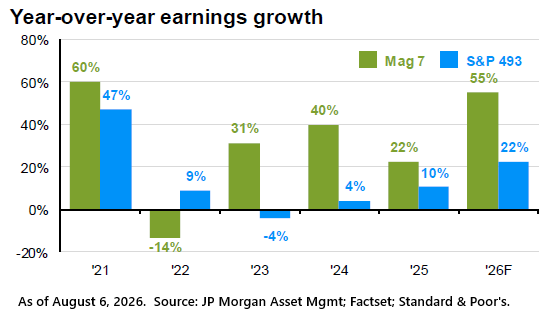
However, it is worth noting two peculiarities with Mag 7 earnings:
- As noted earlier in this letter, hyperscaler AI spend is contributing mightily to the profits of chipmaker Nvidia, one of the Mag 7, while not yet showing up as current costs (instead they are capitalized) by the hyperscalers, so profits in the aggregate are increased. Over time, those costs will be amortized, dampening an unknown level of profits from the sale of AI services.
- Under US accounting rules, Mag 7 investments in Anthropic and OpenAI, as those companies seek to go public, must be marked up on the balance sheets of the investing companies, with this “other income” contributing quite significantly to profits on a current basis.
Higher Rates and a New Fed Chair. This favorable performance for stocks is taking place amidst a backdrop of somewhat higher interest rates. In May, Kevin Warsh took up his role as the new chair of the US Federal Reserve. Warsh had campaigned for the job by arguing for lower interest rates despite his hawkish bent during his prior Fed tenure (2006-2011). With two meetings of the Fed’s rate-setting Open Market Committee (“FOMC”) now in the books under Warsh’s leadership, two things have happened.
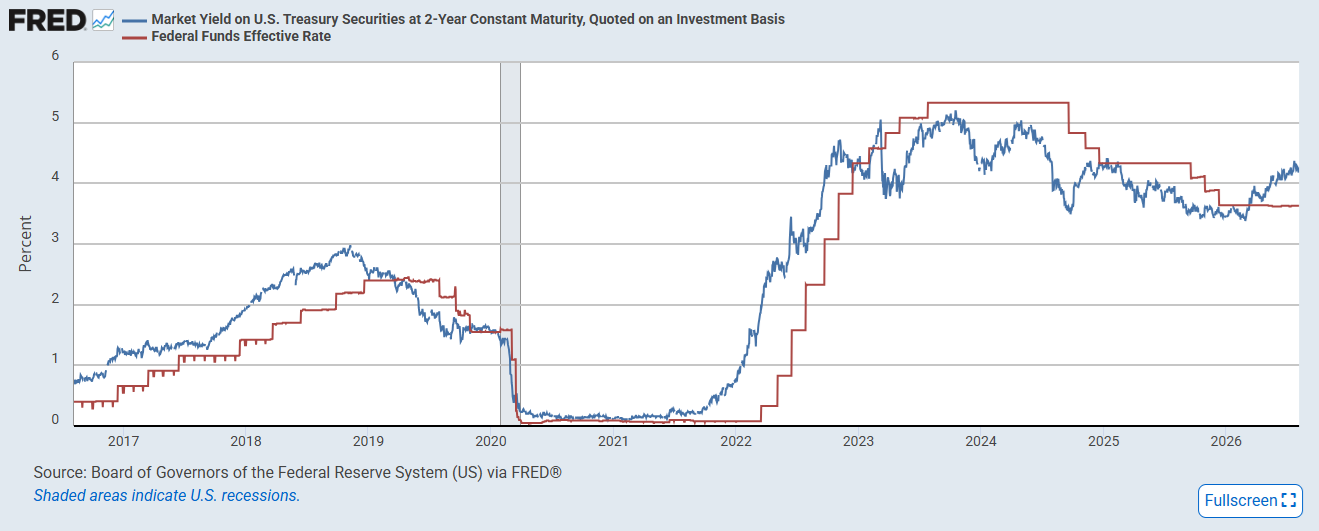
The policy stance of the FOMC has shifted from future cuts towards higher rates, as three members formally dissented and registered their preference for a hike instead of the majority decision to hold the Fed Funds rate steady. The change in stance is noticeable in the yield on the 2-Year Treasury Note, a common measure for the bond market’s view on where Fed Funds should be. That yield is presented below, alongside the Fed Funds rate (more on the relationship later).
The second change is that interest rates on US Treasuries across the range of maturities have moved upward as is evident in the chart below:
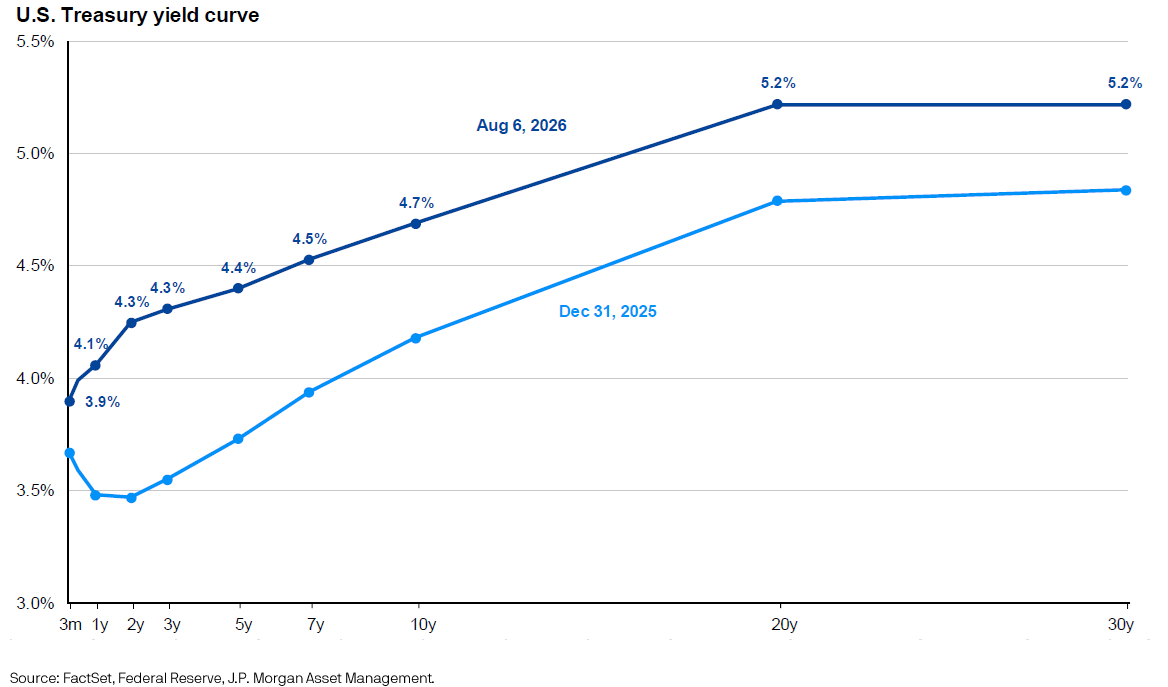
The increase in interest rates across the whole US treasury yield curve is not surprising considering the growing demand for capital owing to the large and persistent US federal budget deficit and the increased business investment spending, including for AI. And more generally, interest rates tend to be correlated with economic growth. To the extent economic growth may be increasing (as seen in better manufacturing activity noted in our prior letter), one should expect higher rates.
But the interesting factor is that part of the cause might be attributable to Warsh himself. Warsh has been a fierce critic of the Fed’s long running balance sheet purchases and the extended zero-interest rate policy (ZIRP) that prevailed from 2008-2017 (and reprised during the Covid pandemic). Warsh also seeks to curtail the extent to which the Fed forecasts its intentions with interest rates, preferring the oracular utterances of recently deceased former Fed chair Alan Greenspan to regular press conferences and detailed rate forecasts begun with Ben Bernanke. In Warsh’s words, he wants the bond market to “play the ball and not the ref.” While one can sympathize with a policy-marker’s desire to have the wisdom of the market crowd indicate where the Fed should take rates, rather than the Fed tell bond investors where to price bonds, there’s a cost in greater interest rate uncertainty moving forward that bond investors may have now priced into the US Treasury market.
And, at least since the end of ZIRP and despite former Fed Chair Jerome Powell’s consistent press conferences and the Fed’s other communications, it appears from the chart (see above) of the 2-Year Treasury and the Fed Funds target that it is the market (through the yield on the 2-Year Note) that is leading the Federal Reserve on where to take rates, rather than the other way around. And as of now, that direction appears higher, as visible in the upward slope of the path of yield in the far right of the aforementioned chart.
As we’ve written in recent years, we are glad that investors have an opportunity to enjoy interest rates that are realistic and historically normal considering current economic conditions. Given greater uncertainty about rates and the bias toward hikes, we are keeping client bond allocations positioned toward shorter-maturity bonds and diversified beyond treasuries and mortgages into corporate bonds, high yield, private credit and a variety of asset-backed bonds. This mix has helped clients preserve sufficient durable assets in case of a stock market retreat, while taking advantage of higher yields in the peripheral areas we mentioned to obtain greater current returns.
If you have questions or want to chat about any of these matters, we be delighted to hear from you.
In the meantime, best wishes for the balance of summer.